maheshika.com
The platform for an expertise business, where the person is the product. Built to answer the questions a buyer actually has before they will get in touch.
- Owner
- Dr. Maheshika Halbeisen
- Type
- Expertise platform, built and operated in-house
- Scale
- 156 pages, 12 API endpoints
- Scope
- Positioning, structure, brand, design, development, AI tooling
- Live at
- maheshika.com
The problem
An expert’s website usually says less than the expert.
When you sell expertise, the website is the whole shop window, and it is almost always the weakest part of the business. The work is excellent. The site says full-service, trusted partner, tailored approach, which is what every competitor says too.
This one was built to fail differently. Every section exists to answer a question a buyer has before they will make contact, and nothing is on the page that does not answer one.
The answer
One line, before anything else.
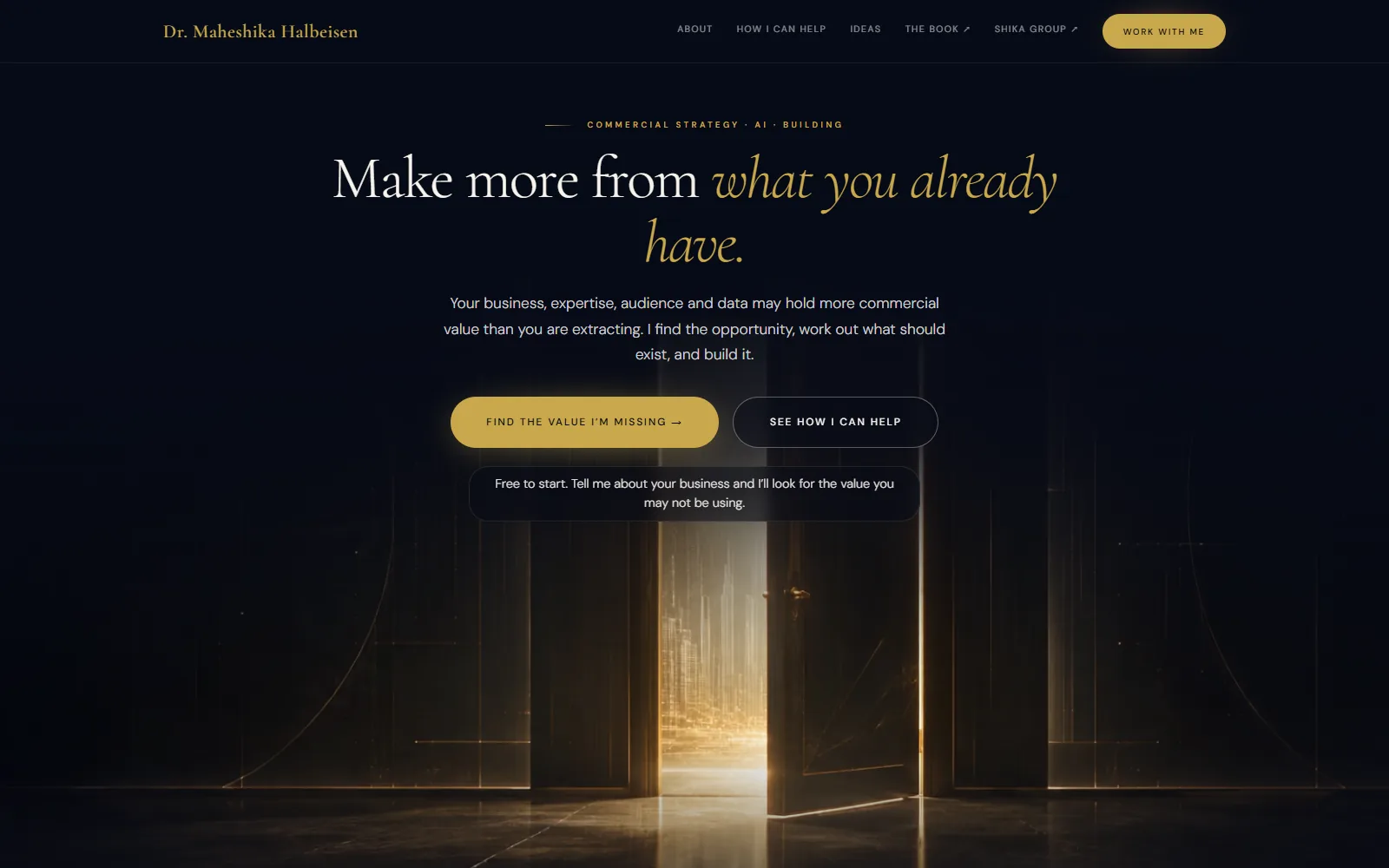
The first thing on the page is Make more from what you already have. Not a category, not a credential, not a welcome. A claim about the reader’s business that they can immediately agree or disagree with.
The sentence underneath does the qualifying: your business, expertise, audience and data may hold more commercial value than you are extracting. Find the opportunity, work out what should exist, build it. A visitor knows inside one screen whether this is for them.
The biography
A background that argues something.
Most professional biographies list roles and say nothing. This one makes a case in a single line: a scientist who became a commercial leader, then a builder. More than twenty years of doing it inside organisations before doing it independently.
That is not decoration. It is the reason the offer is credible, so it is written as an argument rather than as a career history.
The proof
Proof you are allowed to publish.
The hardest problem in professional services is that the best evidence is confidential. The answer here was to stop trying to publish client work and to publish capability instead: the site runs its own tools, free, before anyone is asked for anything.
Behind them sit twelve API endpoints doing real work, with rate limiting, spam handling and payment verification. Strategy is more useful when you can build is the site’s own line, and the site is the demonstration of it. A visitor does not have to take the claim on trust, because they can go and use the thing.
The architecture
Outcomes, not a list of services.
The work is organised as five outcomes, each starting from something the client already owns, rather than as a menu of disciplines. Buyers do not shop for disciplines. They arrive with a problem and need to see it named.
Around that sits the depth an expertise business needs in order to be found at all: 156 pages of articles, tools and answers, each one a legitimate entry point for somebody searching a question rather than a company.
The next step
A next step with a name.
Contact us is not a next step. The site offers a specific, named, free first move instead: tell me about your business, and I will look for the value you are not using.
It is small, it is concrete, and it is the same work the client would eventually pay for, done once at no cost. That is what turns a website from a brochure into a way in.