RareTrial
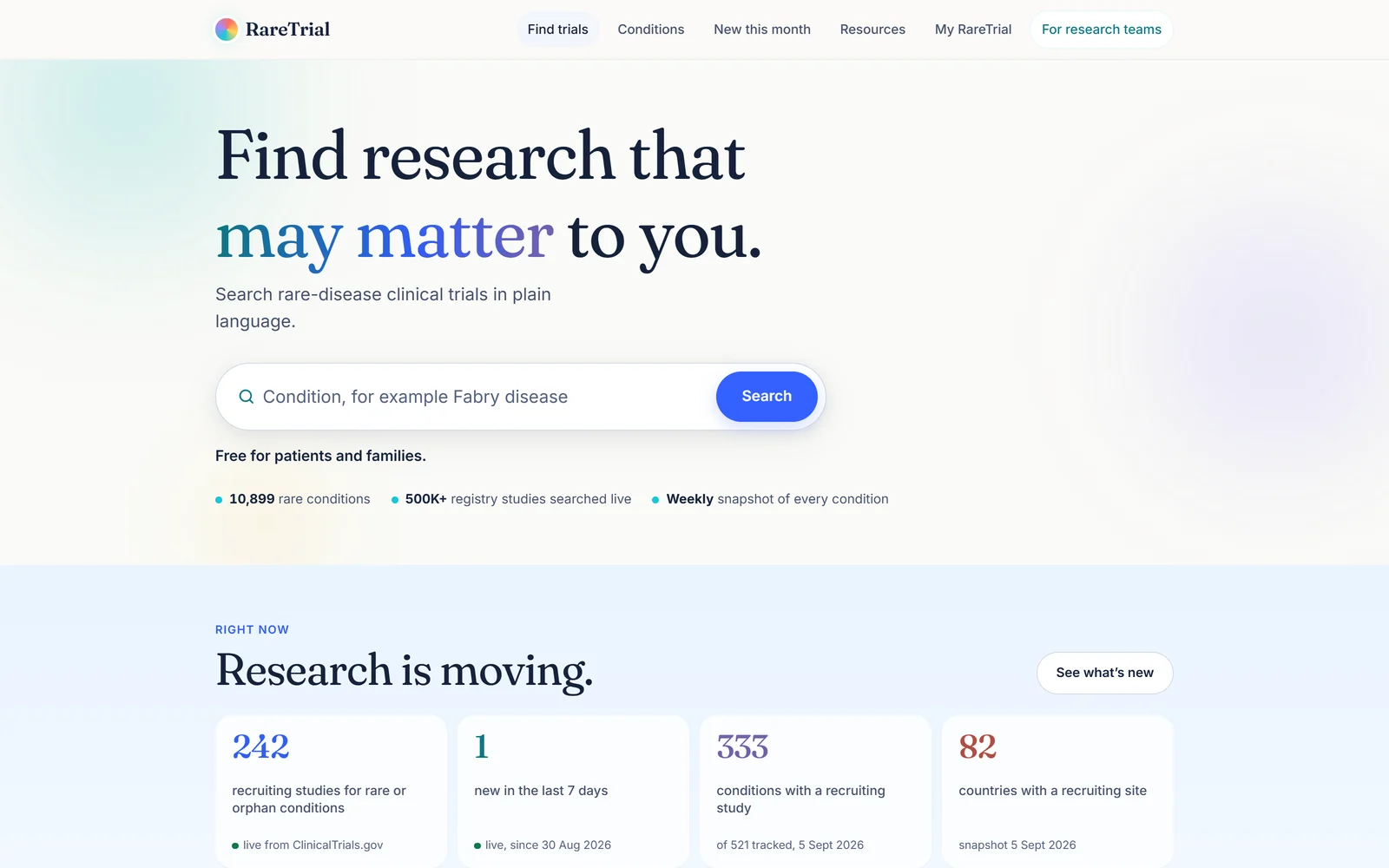
A rare disease clinical trial directory that turns registry data into plain language, across more than ten thousand condition pages.
- Owner
- Shika Group
- Type
- Public directory, built and operated by us
- Scale
- Over 10,000 rare disease pages, drawn from public clinical trial registry data
- Scope
- Information architecture, editorial design, data pipeline, programmatic SEO
- Live at
- raretrial.org
The idea
The information exists. It is just unreadable.
Public clinical trial registries contain the answer to a question thousands of families ask every day: is anyone running a trial for this. The data is open, complete and effectively impossible for a non-specialist to use.
RareTrial takes that registry data and renders it as plain language, one page per condition, for people who are usually reading it on a bad day.
The challenge
Ten thousand pages that each have to be good.
Design at this scale is a different discipline. You are not designing a page, you are designing a system that will generate thousands of them, where you will personally never see most of the output.
Every layout decision has to survive a condition with forty active trials and a condition with none. Every piece of copy has to read naturally whether the disease name is one word or eleven. A template that only looks good on the example you designed it against is not finished.
The direction
Editorial, not clinical.
The obvious visual language for a medical database is a white clinical interface, which is precisely the aesthetic that makes an anxious person feel like a case number.
Instead the site is dark, warm and typographically led, with a high-contrast serif doing the talking. It reads like a serious publication rather than a hospital form, and it is calmer to sit with when the subject matter is frightening.
The build
A pipeline, not a website.
The site is generated from the registry data, so the trial counts stay current without anyone editing pages. The work sits in the transformation: turning registry vocabulary into sentences a person would actually say, and deciding what to omit.
Every page is a real static page. Fast on a poor connection, readable without JavaScript, and legible to search engines and AI assistants, which is how someone actually finds it.
Why it is in this portfolio
It proves something a brochure site cannot.
Most studios can make one beautiful page. Rather fewer can design a system that holds its quality across ten thousand, keep the data honest, and make the result findable.
If you have a directory, a catalogue, a product database or any large body of structured content, this is the capability you are looking for.